ALERT: Risk of Dose Errors with Transition to New Formulation of Rybelsus
A new formulation of Rybelsus (semaglutide) is now available in Canada. The optimized formulation is bioequivalent to the initial formulation, but lower doses of semaglutide are needed to achieve the same therapeutic effect. During the transition period, both formulations may be available in pharmacy, hospital, and/or wholesaler inventories, and references to both may appear in pharmacy or prescriber electronic information systems, potentially increasing the risk for dose equivalency errors.
INTRODUCTION
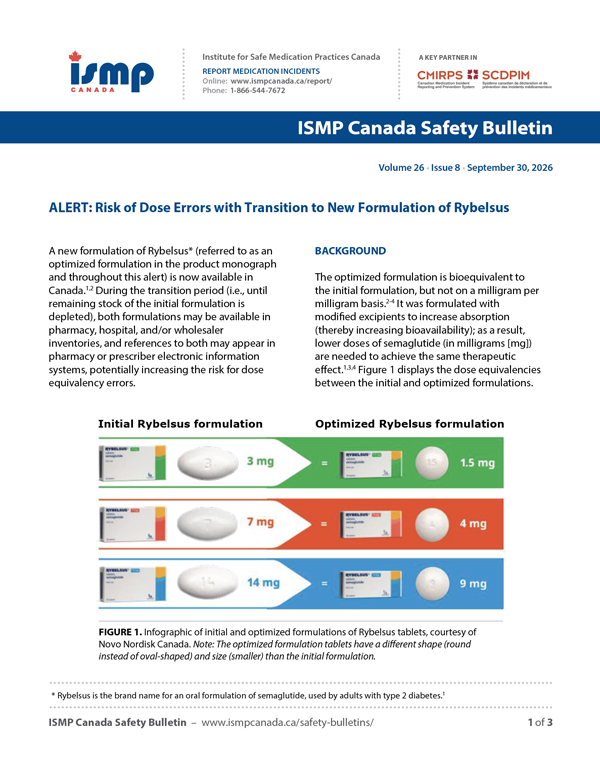
A new formulation of Rybelsus* (referred to as an optimized formulation in the product monograph and throughout this alert) is now available in Canada.1,2 During the transition period (i.e., until remaining stock of the initial formulation is depleted), both formulations may be available in pharmacy, hospital, and/or wholesaler inventories, and references to both may appear in pharmacy or prescriber electronic information systems, potentially increasing the risk for dose equivalency errors.
BACKGROUND
The optimized formulation is bioequivalent to the initial formulation, but not on a milligram per milligram basis.2-4 It was formulated with modified excipients to increase absorption (thereby increasing bioavailability); as a result, lower doses of semaglutide (in milligrams [mg]) are needed to achieve the same therapeutic effect.1,3,4 Figure 1 displays the dose equivalencies between the initial and optimized formulations.
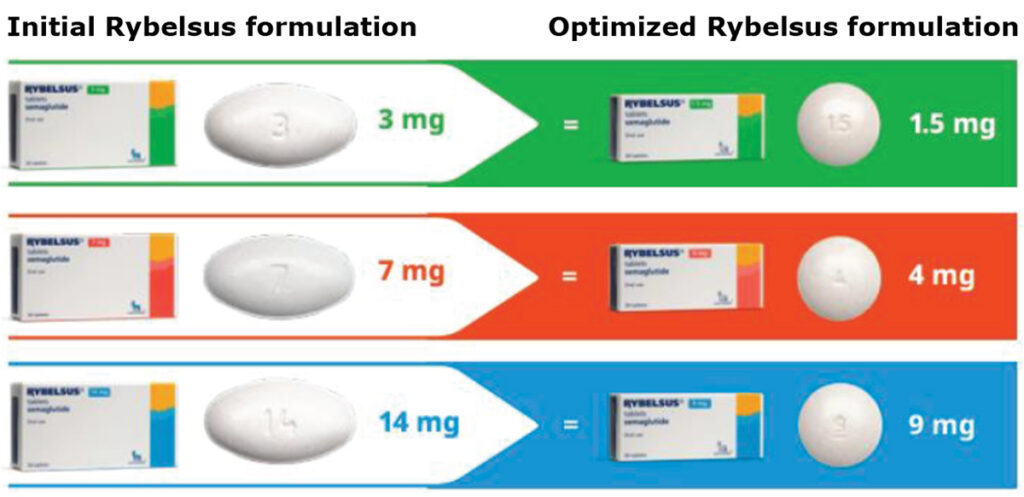
FIGURE 1. Infographic of initial and optimized formulations of Rybelsus tablets, courtesy of Novo Nordisk Canada. Note: The optimized formulation tablets have a different shape (round instead of oval-shaped) and size (smaller) than the initial formulation.
INCIDENT EXAMPLES
- A refill request for Rybelsus 7 mg (initial formulation) was dispensed with a mix of 3 mg (initial formulation) and 4 mg (optimized formulation) tablets; this was equivalent to 10 mg of the initial formulation. This incident was discovered during prescription pick-up.
- A prescription for Rybelsus 9 mg (optimized formulation) was dispensed as 3 mg (initial formulation) tablets with directions to take 3 tablets daily; this was equivalent to 4.5 mg of the optimized formulation. This incident was recognized during a medication review.
DISCUSSION
Canadian pharmacists have reported concerns about the lack of awareness of the optimized formulation, the difficulty in differentiating the initial and optimized formulations in electronic systems (Figure 2), the need to convert doses when using the optimized formulation (Figure 1), and the availability of both formulations on pharmacy shelves.
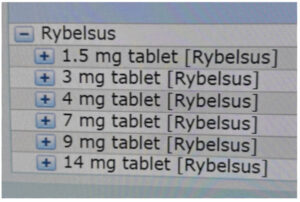
FIGURE 2. Screenshot of Rybelsus selection options from an electronic system. Note the lack of differentiation between initial and optimized formulations of Rybelsus.
RECOMMENDATIONS
Given that both formulations may still be available in electronic systems and wholesaler inventories, and on pharmacy shelves, the following actions can help prevent dose equivalency errors.
Electronic Systems
- Distinguish the initial and optimized formulations of Rybelsus in electronic systems, including patient records, prescribing modules, pharmacy systems, and medication administration records.
- Create a pop-up in electronic systems to alert users to the optimized formulation of Rybelsus and provide dose equivalency information (Figure 1).
- Once stock of the initial formulation has been depleted, deactivate the corresponding drug files in electronic systems.
Pharmacy Processes
- Communicate within the circle of care about the optimized formulation. Pharmacists can switch patients to the equivalent optimized formulation, document the change, and inform the prescriber.5
- Place a warning about dose equivalencies on the shelf where Rybelsus products are stored.
Patient/Caregiver Engagement
- Inform patients/caregivers about the change in tablet strength, shape, and size (i.e., lower, round, and smaller). Emphasize that Rybelsus is always to be taken as a single tablet once daily and tablets should not be combined to make up a dose.1,5 Describe the potential risk of harm if the different formulations are inadvertently mixed up or combined.
- Help patients/caregivers to update their own medication lists to reflect the change in strength of Rybelsus.

The Canadian Medication Incident Reporting and Prevention System (CMIRPS) is a collaborative pan-Canadian program of Health Canada, the Canadian Institute for Health Information (CIHI), the Institute for Safe Medication Practices Canada (ISMP Canada) and Healthcare Excellence Canada (HEC). The goal of CMIRPS is to reduce and prevent harmful medication incidents in Canada.
Funding support provided by Health Canada. The views expressed herein do not necessarily represent the views of Health Canada.

The Healthcare Insurance Reciprocal of Canada (HIROC) provides support for the bulletin and is a member owned expert provider of professional and general liability coverage and risk management support.

The Institute for Safe Medication Practices Canada (ISMP Canada) is an independent national not-for-profit organization committed to the advancement of medication safety in all healthcare settings. ISMP Canada’s mandate includes analyzing medication incidents, making recommendations for the prevention of harmful medication incidents, and facilitating quality improvement initiatives.
Report Medication Incidents (Including near misses)
Online: ismpcanada.ca/report/
Phone: 1-866-544-7672
ISMP Canada strives to ensure confidentiality and security of information received, and respects the wishes of the reporter as to the level of detail to be included in publications.
Stay Informed
Subscribe to the ISMP Canada Safety Bulletins and Newsletters.
This bulletin shares information about safe medication practices, is noncommercial, and is therefore exempt from Canadian anti-spam legislation.
Contact Us
Email: cmirps@ismpcanada.ca
Phone: 1-866-544-7672
©2026 Institute for Safe Medication Practices Canada.