ALERT: Hand Sanitizers That Look Like Drinks
In this time of shortages across the country, many companies have taken up the call to manufacture hand sanitizers, so there is greater access to these products. There is a risk that hand sanitizer will be swallowed by accident by an adult or child when it is provided in containers that are usually used for drinks such as soda, water, and alcoholic beverages.

INTRODUCTION
In this time of shortages across the country, many companies have taken up the call to manufacture hand sanitizers, so there is greater access to these products. There is a risk that hand sanitizer will be swallowed by accident by an adult or child when it is provided in containers that are usually used for drinks such as soda, water, and alcoholic beverages.
INCIDENT
ISMP Canada received a recent report from a concerned consumer about a hand sanitizer (Figure 1) being sold in a grocery store. He picked up a bottle thinking it contained a drink but soon realized it was hand sanitizer. The consumer shared that the product inside the bottle was a liquid, not a gel—it looked just like water. He was concerned that the product would be mistaken for water and ingested.
RISK OF ACCIDENTAL POISONING
Many companies are trying their best to get hand sanitizers out to those who need them, but they may be limited in their ability to create or find appropriate packaging. For example, the manufacturer of the product in Figure 1 has reported difficulty in obtaining bottles normally used for household products. Instead, the manufacturer is distributing its hand sanitizer in 2-litre bottles (as shown) and 500-mL containers commonly used for drinks like soda and water. Others are using containers that are already available in their pre-pandemic production processes, such as wine and liquor bottles1 (Figures 2 and 3). In some cases, the labels and branding are similar to known alcoholic beverages, possibly increasing the risk of accidental poisoning.
Another potential concern is the reduced ability for consumers to recognize that the product is not intended for drinking because of its taste. Most hand sanitizers contain alcohol that has been deliberately denatured. This process makes the alcohol taste bad, which alerts the consumer (especially important for children) that it should not be consumed. The use of denaturants in hand sanitizers is usually required by Health Canada; however, during the pandemic, there is a strong recommendation rather than a requirement for denaturants, in an effort to ramp up production.2
Hand sanitizers contain a higher concentration of alcohol (usually more than 60%) than would normally be found in alcoholic beverages. Drinking hand sanitizer can lead to alcohol poisoning. Children are especially vulnerable. Even drinking an amount as small as 30 mL (about 2 tablespoons) can cause the death of a young child.3 A report from the United States described alcohol poisoning in a young teen who drank hand sanitizer that was not denatured and distributed in a liquor bottle.4
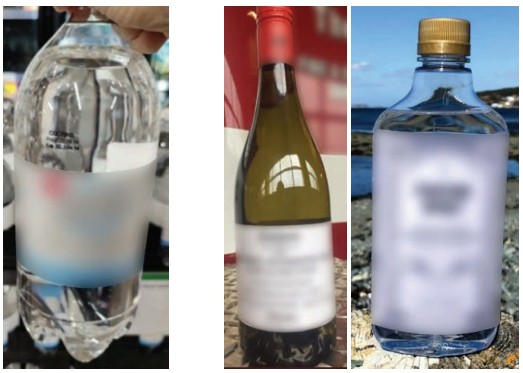
FIGURE 1 (left): Photo of a hand sanitizer sold in a 2-litre bottle usually used for drinks. FIGURES 2 AND 3 (right): Examples of hand sanitizers sold in wine or liquor bottles.
RECOMMENDATIONS
The recommendations below are intended for liquid (not gel) hand sanitizer products bottled in containers that are normally used for drinks.
For consumers
- Store these products out of the reach of children.
- Pour the hand sanitizer into a different container (such as a spray bottle) that has been emptied, cleaned, and dried. Alternatively, replace the cap of the existing bottle with a pump to make the product look different from drink containers. Make sure the bottle that contains the hand sanitizer is labeled, including “For external use only”.
- Call the local poison centre if you believe anyone in your household has swallowed any amount of hand sanitizer. This step is especially important if children are involved. To find a list of all local poison centres in Canada, see the “Provincial Centres” tab at http://www.capcc.ca/en. Write down the number for your local centre, and keep it in a handy spot.
- Share this alert with managers at stores that sell any hand sanitizer product bottled in drink containers.
For companies considering the manufacture of hand sanitizers
- Package hand sanitizers in containers similar to those used for existing hand sanitizers or household products (Figures 4 to 7). Avoid containers that are commonly used for drinks. If suitable containers are not available, consider altering the cap (e.g., by replacing a screw cap with a pump).
- Denature the alcohol used to manufacture hand sanitizer, if possible, making it unpalatable, to serve as a warning to consumers during accidental ingestion.
- Redesign the label so critical information and warnings (e.g., “Hand sanitizer, for external use only”) are more prominent. Highlight the bottle contents and put less emphasis on the branding.
- Add prominent warning labels to existing products to alert consumers that they are for external use only, as well as hazard symbols to show the product is poisonous and flammable.
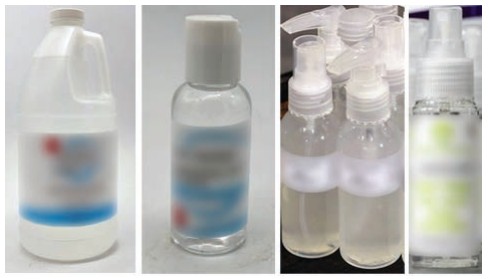
FIGURES 4 TO 7: Examples of hand sanitizers manufactured by companies that do not usually make such products, and bottled in household product containers.
For retailers
- Consider adding prominent warning labels to existing products to alert consumers that they are for external use only.
- Stock hand sanitizer products in a location with other hand or household cleaning products and NOT near drinks.
- Ensure there is a large “Hand Sanitizer” sign(s) displayed with the product.
- Consider placing a copy of this alert in front of any hand sanitizer product sold in beverage bottles.
- If your retail outlet is already carrying hand sanitizer products that may carry a higher risk for accidental ingestion, consider redirecting the products to a health care facility (e.g., long-term care home), where health care providers can be expected to use the products more safely.
ISMP Canada is communicating with manufacturers to help to improve the packaging and labelling of hand sanitizer products and with Health Canada to enhance the specifications for safer packaging and labelling. Many retailers, such as grocery stores and pharmacies, and consumer organizations are being notified and are encouraged to share this alert.

The Canadian Medication Incident Reporting and Prevention System (CMIRPS) is a collaborative pan-Canadian program of Health Canada, the Canadian Institute for Health Information (CIHI), the Institute for Safe Medication Practices Canada (ISMP Canada) and Healthcare Excellence Canada (HEC). The goal of CMIRPS is to reduce and prevent harmful medication incidents in Canada.
Funding support provided by Health Canada. The views expressed herein do not necessarily represent the views of Health Canada.

The Healthcare Insurance Reciprocal of Canada (HIROC) provides support for the bulletin and is a member owned expert provider of professional and general liability coverage and risk management support.

The Institute for Safe Medication Practices Canada (ISMP Canada) is an independent national not-for-profit organization committed to the advancement of medication safety in all healthcare settings. ISMP Canada’s mandate includes analyzing medication incidents, making recommendations for the prevention of harmful medication incidents, and facilitating quality improvement initiatives.
Report Medication Incidents (Including near misses)
Online: ismpcanada.ca/report/
Phone: 1-866-544-7672
ISMP Canada strives to ensure confidentiality and security of information received, and respects the wishes of the reporter as to the level of detail to be included in publications.
Stay Informed
Subscribe to the ISMP Canada Safety Bulletins and Newsletters.
This bulletin shares information about safe medication practices, is noncommercial, and is therefore exempt from Canadian anti-spam legislation.
Contact Us
Email: cmirps@ismpcanada.ca
Phone: 1-866-544-7672
©2026 Institute for Safe Medication Practices Canada.