Opportunities to Improve Electronic Presentation of Medication Information
This supplement describes identified opportunities to improve electronic presentation of medication information. Reported incidents were related to prescribing modules within electronic medical records, medication administration records, and pharmacy management software.
One of the benefits of electronic presentation of medication information is eliminating misinterpretation errors due to illegible handwriting. At the same time, however, new types of safety vulnerabilities can be introduced.1-3 Recent analysis work to update the Do Not Use: Dangerous Abbreviations, Symbols, and Dose Designations list identified opportunities to improve the presentation of medication information in electronic form. Reported incidents were related to prescribing modules within electronic medical records, medication administration records, and pharmacy management software.
1. Sufficient Space for Input of Medication Name
Electronic inputs often have limits on the number of characters permitted. For medication names, such limits typically affect combination products and biologics/biosimilars for which there is a need to communicate multiple medication names and/or lengthy product names. In reported incidents, names were sometimes truncated, or shortened, contributing to errors involving incorrect product selection.
TIP:
Work with software vendors to provide sufficient space to input full medication names.2
2. A Prompt That More Information Is Available than Is Displayed
With the increasing use of mobile devices, the size of the screen display is limited, making it necessary for users to scroll for further information.
Incident Example:
Some of the instructions for the use of risperidone, as provided in the medication administration record, were missed by staff, who were using a mobile device. There was no prompt to indicate that the record contained more information than appeared in the initial display. This oversight was reported to have contributed to an error in carrying out the treatment plan.
TIP:
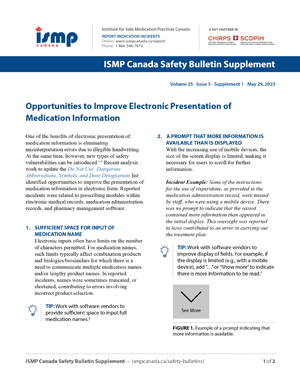
Work with software vendors to improve display of fields. For example, if the display is limited (e.g., with a mobile device), add “…” or “Show more” to indicate there is more information to be read.3

FIGURE 1. Example of a prompt indicating that more information is available.
3. Adequate Spacing between Medication Name and Dose
Spacing between elements of medication information (e.g., drug name, dose, unit of measure)2,3 is critical to readability and understanding; inadequate spacing can lead to misinterpretation.
Incident Example:
“Propranolol20mg” was mistakenly interpreted as “propranolol 120 mg” because the drug name and dose were presented in close proximity on an electronic prescription. As a result, an overdose occurred.
TIP:
Report concerns related to elements of medication information (e.g., illegibility due to inadequate spacing) through organizational reporting programs, to enable analysis and solution development.
4. User-Tested Mnemonics or “Quick Codes”
Mnemonics or quick codes are shortcuts that, when entered in the appropriate field, expand to their full description. They are designed for efficiency but contributed to incidents when the converted information was not carefully reviewed.
Incident Example:
The quick code “AAA” (meaning “apply to affected area”) was entered in the instruction field. However, the short form did not expand to the full text, and “AAA” was the only direction appearing on the medication label. As a result, the patient was confused about how to use the product.
TIP:
Conduct end-user testing for mnemonics.
5. Five-Letter Input Requirement to Display Medication Names in Drop-Down Menus
Increasing the number of characters that must be input before a drop-down menu appears can reduce the risk of errors by reducing the number of selection options for similarly named medications.
Incident Example:
For a metronidazole prescription, the letters “m-e-t” were typed into the system. A drop-down menu appeared, presenting both “metformin” and “metronidazole”. Metformin was inadvertently selected, instead of the intended metronidazole.
TIP:
Work with software vendors to require, at a minimum, 5 letters of the intended medication name to be entered before selection options are presented in a drop-down menu.2
The presentation of electronic medication information should be designed to meet the needs of end users and to strengthen safety. Health care providers, software developers, and human factors experts are encouraged to report concerns and to regularly review the presentation of electronic medication information to identify quality improvement opportunities.

The Canadian Medication Incident Reporting and Prevention System (CMIRPS) is a collaborative pan-Canadian program of Health Canada, the Canadian Institute for Health Information (CIHI), the Institute for Safe Medication Practices Canada (ISMP Canada) and Healthcare Excellence Canada (HEC). The goal of CMIRPS is to reduce and prevent harmful medication incidents in Canada.
Funding support provided by Health Canada. The views expressed herein do not necessarily represent the views of Health Canada.

The Healthcare Insurance Reciprocal of Canada (HIROC) provides support for the bulletin and is a member owned expert provider of professional and general liability coverage and risk management support.

The Institute for Safe Medication Practices Canada (ISMP Canada) is an independent national not-for-profit organization committed to the advancement of medication safety in all healthcare settings. ISMP Canada’s mandate includes analyzing medication incidents, making recommendations for the prevention of harmful medication incidents, and facilitating quality improvement initiatives.
Report Medication Incidents (Including near misses)
Online: ismpcanada.ca/report/
Phone: 1-866-544-7672
ISMP Canada strives to ensure confidentiality and security of information received, and respects the wishes of the reporter as to the level of detail to be included in publications.
Stay Informed
Subscribe to the ISMP Canada Safety Bulletins and Newsletters.
This bulletin shares information about safe medication practices, is noncommercial, and is therefore exempt from Canadian anti-spam legislation.
Contact Us
Email: cmirps@ismpcanada.ca
Phone: 1-866-544-7672
©2026 Institute for Safe Medication Practices Canada.