Analysis of Medication Incident Data across Care Settings Informs Quality Improvement in Cancer Care
Delivery of cancer care involves coordination among multiple health care providers and services. Patients receiving anti-cancer treatment, which involves high-alert medications, frequently transition between acute and ambulatory care settings. This bulletin describes an initiative led by the Nova Scotia Health Cancer Care Program to identify vulnerabilities and inform quality improvement in the delivery of oral anti-cancer treatment.
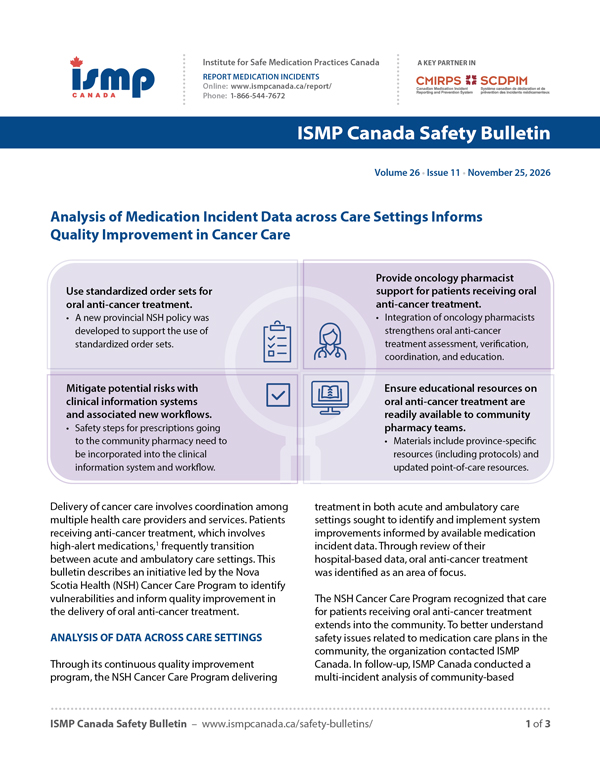

Use standardized order sets for oral anti-cancer treatment.
A new provincial NSH policy was developed to support the use of standardized order sets.

Mitigate potential risks with clinical information systems and associated new workflows.
Safety steps for prescriptions going to the community pharmacy need to be incorporated into the clinical information system and workflow.

Provide oncology pharmacist support for patients receiving oral anti-cancer treatment.
Integration of oncology pharmacists strengthens oral anti-cancer treatment assessment, verification, coordination, and education.

Ensure educational resources on oral anti-cancer treatment are readily available to community pharmacy teams.
Materials include province-specific resources (including protocols) and updated point-of-care resources.
INTRODUCTION
Delivery of cancer care involves coordination among multiple health care providers and services. Patients receiving anti-cancer treatment, which involves high-alert medications,1 frequently transition between acute and ambulatory care settings. This bulletin describes an initiative led by the Nova Scotia Health (NSH) Cancer Care Program to identify vulnerabilities and inform quality improvement in the delivery of oral anti-cancer treatment.
ANALYSIS OF DATA ACROSS CARE SETTINGS
Through its continuous quality improvement program, the NSH Cancer Care Program delivering treatment in both acute and ambulatory care settings sought to identify and implement system improvements informed by available medication incident data. Through review of their hospital-based data, oral anti-cancer treatment was identified as an area of focus.
The NSH Cancer Care Program recognized that care for patients receiving oral anti-cancer treatment extends into the community. To better understand safety issues related to medication care plans in the community, the organization contacted ISMP Canada. In follow-up, ISMP Canada conducted a multi-incident analysis of community-based incident reports from Nova Scotia for a recent 5-year period. Data were extracted from relevant Canadian Medication Incident Reporting and Prevention System (CMIRPS) databases,† and the analysis findings were shared with the organization.
KEY RECOMMENDATIONS
Analysis of data across acute and ambulatory care settings identified several factors contributing to incidents and informed development of the recommendations presented below.
Use standardized order sets for oral anti-cancer treatment.
The NSH Cancer Care Program now requires the use of standardized order sets (preprinted or as part of computerized prescriber order entry [CPOE]) for oral anti-cancer treatment, a requirement that is supported by a new provincial NSH policy. Implementation of standardized order sets can help to improve prescribing practices and reduce variability in medication orders.
- Incomplete, incorrect, or illegible medication orders (often associated with incorrect dose/frequency) were identified as contributing factors in reported incidents.
Mitigate potential risks with clinical information systems and associated new workflows.
The NSH Cancer Care Program is ensuring that the safety steps undertaken by an oncology pharmacist for oral anti-cancer treatment prescriptions are continued as workflow incorporates the electronic clinical information system. These safety steps can help in the recognition and resolution of prescribing errors before they reach the community pharmacy team and the patient/caregiver.
- The lack of a quality check was identified as a contributing factor in reported incidents.
Provide oncology pharmacist support for patients receiving oral anti-cancer treatment.
The NSH Cancer Care Program advocated for the integration of oncology pharmacists in the care for all patients across the province using anti-cancer treatment. When fully implemented, the oncology pharmacist would be responsible for assessing, verifying, coordinating, and providing education on oral anti-cancer treatment. A parallel process had already been established to integrate similar safety checks for parenteral anti-cancer treatment.
- Patient communication factors and staff lacking oncology expertise were identified as contributing factors in reported incidents. Engaging the patient/caregiver as an integral part of the circle of care can help them to optimize information-sharing with health care providers across care settings.
Ensure educational resources on oral anti-cancer treatment are readily available to community pharmacy teams.
The NSH Cancer Care Program recommended sharing specialized knowledge and resources related to oral anti-cancer treatment with community pharmacy teams through the provincial pharmacy association.‡ Materials include province-specific resources (including protocols) and updated point-of-care resources on oral anti-cancer treatment and other oncology topics.
- Insufficient knowledge (specifically, lack of recognition of clinically relevant drug interactions) was identified as a contributing factor in reported incidents.
CALL TO ACTION
This provincial NSH quality improvement initiative identified opportunities to strengthen the safety of oral anti-cancer treatment through the use of standardized order sets, risk mitigation with clinical information systems, integration of oncology pharmacists in care for patients across the province, and resource sharing with community pharmacy teams.

The Canadian Medication Incident Reporting and Prevention System (CMIRPS) is a collaborative pan-Canadian program of Health Canada, the Canadian Institute for Health Information (CIHI), the Institute for Safe Medication Practices Canada (ISMP Canada) and Healthcare Excellence Canada (HEC). The goal of CMIRPS is to reduce and prevent harmful medication incidents in Canada.
Funding support provided by Health Canada. The views expressed herein do not necessarily represent the views of Health Canada.

The Healthcare Insurance Reciprocal of Canada (HIROC) provides support for the bulletin and is a member owned expert provider of professional and general liability coverage and risk management support.

The Institute for Safe Medication Practices Canada (ISMP Canada) is an independent national not-for-profit organization committed to the advancement of medication safety in all healthcare settings. ISMP Canada’s mandate includes analyzing medication incidents, making recommendations for the prevention of harmful medication incidents, and facilitating quality improvement initiatives.
Report Medication Incidents (Including near misses)
Online: ismpcanada.ca/report/
Phone: 1-866-544-7672
ISMP Canada strives to ensure confidentiality and security of information received, and respects the wishes of the reporter as to the level of detail to be included in publications.
Stay Informed
Subscribe to the ISMP Canada Safety Bulletins and Newsletters.
This bulletin shares information about safe medication practices, is noncommercial, and is therefore exempt from Canadian anti-spam legislation.
Contact Us
Email: cmirps@ismpcanada.ca
Phone: 1-866-544-7672
©2026 Institute for Safe Medication Practices Canada.