Reaffirming the “Do Not Use: Dangerous Abbreviations, Symbols and Dose Designations” List
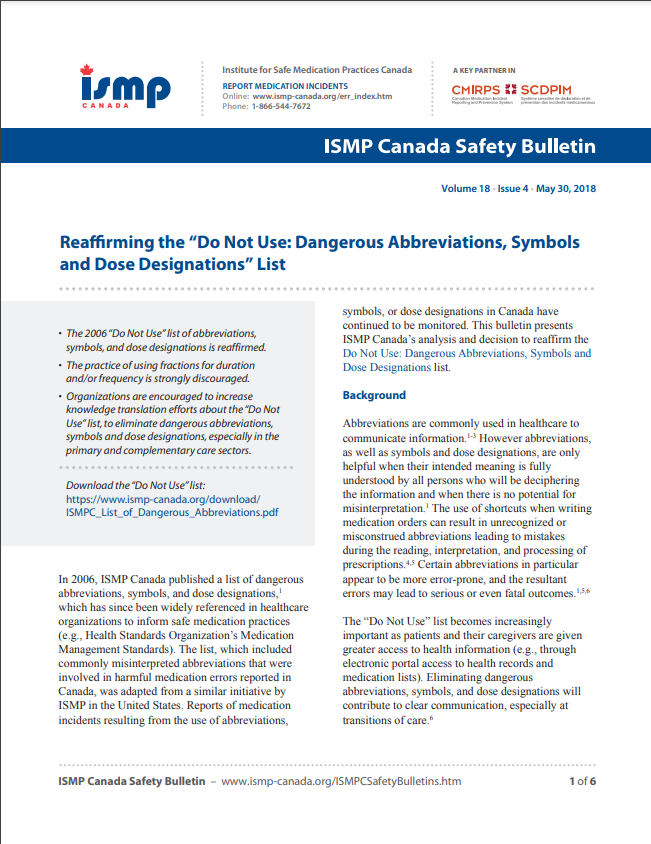
This bulletin presents ISMP Canada’s analysis and decision to reaffirm the Do Not Use: Dangerous Abbreviations, Symbols and Dose Designations List.
- Archived 2018 Do Not Use list
- The 2006 “Do Not Use” list of abbreviations, symbols, and dose designations is reaffirmed.
- The practice of using fractions for duration and/or frequency is strongly discouraged.
- Organizations are encouraged to increase knowledge translation efforts about the “Do Not Use” list, to eliminate dangerous abbreviations, symbols and dose designations, especially in the primary and complementary care sectors.
Download the “Do Not Use” list: https://www.ismp-canada.org/download/ISMPC_List_of_Dangerous_Abbreviations.pdf
INTRODUCTION
In 2006, ISMP Canada published a list of dangerous abbreviations, symbols, and dose designations,1 which has since been widely referenced in healthcare organizations to inform safe medication practices (e.g., Health Standards Organization’s Medication Management Standards). The list, which included commonly misinterpreted abbreviations that were involved in harmful medication errors reported in Canada, was adapted from a similar initiative by ISMP in the United States. Reports of medication incidents resulting from the use of abbreviations, symbols, or dose designations in Canada have continued to be monitored. This bulletin presents ISMP Canada’s analysis and decision to reaffirm the Do Not Use: Dangerous Abbreviations, Symbols and Dose Designations list.
BACKGROUND
Abbreviations are commonly used in healthcare to communicate information.1-3 However abbreviations, as well as symbols and dose designations, are only helpful when their intended meaning is fully understood by all persons who will be deciphering the information and when there is no potential for misinterpretation.1 The use of shortcuts when writing medication orders can result in unrecognized or misconstrued abbreviations leading to mistakes during the reading, interpretation, and processing of prescriptions.4,5 Certain abbreviations in particular appear to be more error-prone, and the resultant errors may lead to serious or even fatal outcomes.1,5,6
The “Do Not Use” list becomes increasingly important as patients and their caregivers are given greater access to health information (e.g., through electronic portal access to health records and medication lists). Eliminating dangerous abbreviations, symbols, and dose designations will contribute to clear communication, especially at transitions of care.6
METHODOLOGY
An environmental scan of academic and grey literature since 2006 was undertaken to identify abbreviations, symbols and dose designations of concern. The scan captured initiatives developed by agencies such as the Australian Commission on Safety and Quality in Health Care7 and the Health Quality Council of Alberta.8
The Canadian healthcare community was invited to submit abbreviations, symbols, and dose designations of concern to ISMP Canada, which were captured in ISMP Canada’s Individual Practitioner Reporting (IPR) program. Reports of all concerns and medication incidents related to the use of abbreviations were extracted from 3 ISMP Canada reporting databases (IPR, Community Pharmacy Incident Reporting, and Consumer Reporting) and the National System for Incident Reporting† (NSIR) for the period January 2006 to January 2018.
Key phrases used to identify relevant literature in the environmental scan and incident reports in the reporting databases included “abbrev*”, “dangerous”, “error prone”, “designat*”, “acronym”, and “short form”. A total of 6239 incidents were reviewed, of which 248 relevant incidents were selected for further analysis. In addition, 33 abbreviation-related queries and reports received by ISMP Canada’s information support service were analyzed. Abbreviations on the original list were reviewed to determine if they continue to pose a potential risk of harm.
ANALYSIS AND FINDINGS
The environmental scan and database analysis showed that the abbreviations, symbols, and dose designations included on the original “Do Not Use” list continue to contribute to harmful medication incidents in some healthcare settings, such as in the primary and complementary‡ care sectors.
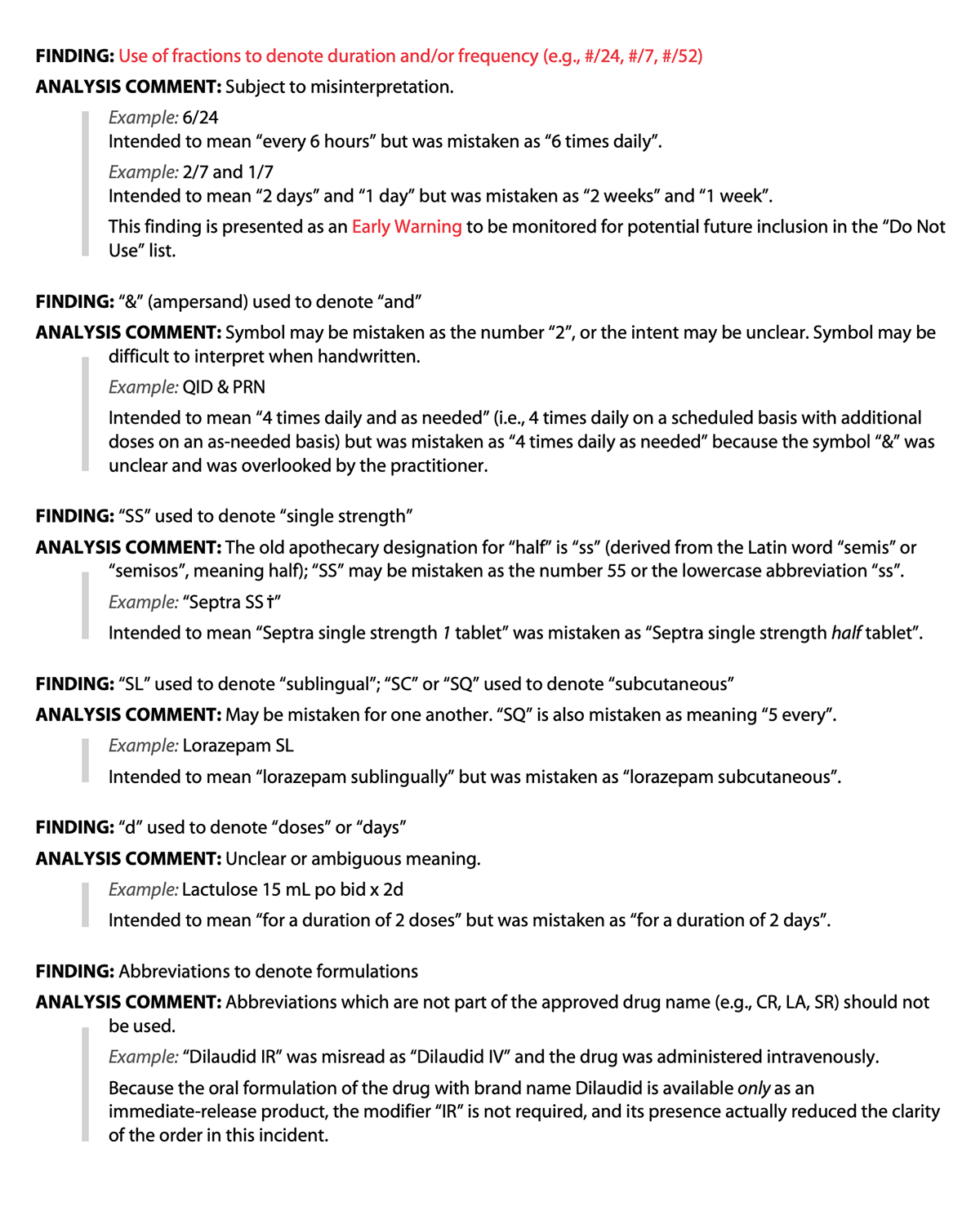
The analysis identified several additional abbreviations and symbols as having some association with harm or the potential for harm. In particular, the use of a fraction (e.g., # 24, # 7, # 52) to denote duration and/or frequency has been misunderstood and has led to a number of harmful errors.
Incident example: The written tapering directions for a corticosteroid were that the doses be given for “2 7” and then “1 7”. The intended meaning was that the prescribed dose be given “for 2 days” and then “for 1 day”, but the instructions were interpreted to mean treatment “for 2 weeks” and then “for 1 week”. The patient received a longer duration of therapy than was intended and experienced adverse effects for which admission to hospital was required.
The use of route designations such as SL, SQ, and SC, use of the abbreviation “d” to represent days or doses, and use of the ampersand symbol (&) to denote the word “and” were also scrutinized.
Table 1 shares selected findings of this analysis.
Table 1: Selected Findings and Analysis Comments
Numerous activities (e.g., audits of medication orders) and knowledge translation initiatives (e.g., e‑learning modules) in acute care hospitals have had success in emphasizing the benefits of reducing or eliminating the use of dangerous abbreviations, symbols, and dose designations.
A recent Canadian hospital audit found the rates of dangerous abbreviation use on electronic medication orders was significantly less than on paper orders (0.4% vs. 24.1%, respectively).3 Complementing these initiatives, there have also been improvements in medication labelling and packaging following the release of Health Canada’s Good Label and Package Practices Guides.9,10
Despite improvements in the acute care sector, dangerous abbreviations, symbols, and dose designations remain in use in the healthcare system. A recent ISMP Canada Safety Bulletin5 highlighted the need for healthcare practitioners in both the primary and complementary care sectors to avoid the use of dangerous abbreviations, symbols and dose designations.
RECOMMENDATIONS AND CONCLUSION
Recommendation: the practice of using fractions for duration and/or frequency is discouraged. The analysis identified incidents resulting in patient harm associated with the use of fractions to denote duration and/or frequency. This finding is presented as an Early Warning to be monitored for potential future inclusion in the “Do Not Use” list.
Recommendation: knowledge translation efforts to eliminate dangerous abbreviations, symbols and dose designations need to continue, especially in the primary and complementary care sectors. Continued awareness and reporting of abbreviations, symbols, and dose designations that might lead to harmful incidents is encouraged.
The “Do Not Use” list considers reported harm (actual or potential), and the frequency of use and/or misinterpretation of abbreviations, symbols or dose designations. After analysis and review of new data and findings from the environmental scan, the list has been reaffirmed.

The Canadian Medication Incident Reporting and Prevention System (CMIRPS) is a collaborative pan-Canadian program of Health Canada, the Canadian Institute for Health Information (CIHI), the Institute for Safe Medication Practices Canada (ISMP Canada) and Healthcare Excellence Canada (HEC). The goal of CMIRPS is to reduce and prevent harmful medication incidents in Canada.
Funding support provided by Health Canada. The views expressed herein do not necessarily represent the views of Health Canada.

The Healthcare Insurance Reciprocal of Canada (HIROC) provides support for the bulletin and is a member owned expert provider of professional and general liability coverage and risk management support.

The Institute for Safe Medication Practices Canada (ISMP Canada) is an independent national not-for-profit organization committed to the advancement of medication safety in all healthcare settings. ISMP Canada’s mandate includes analyzing medication incidents, making recommendations for the prevention of harmful medication incidents, and facilitating quality improvement initiatives.
Report Medication Incidents (Including near misses)
Online: ismpcanada.ca/report/
Phone: 1-866-544-7672
ISMP Canada strives to ensure confidentiality and security of information received, and respects the wishes of the reporter as to the level of detail to be included in publications.
Stay Informed
Subscribe to the ISMP Canada Safety Bulletins and Newsletters.
This bulletin shares information about safe medication practices, is noncommercial, and is therefore exempt from Canadian anti-spam legislation.
Contact Us
Email: cmirps@ismpcanada.ca
Phone: 1-866-544-7672
©2026 Institute for Safe Medication Practices Canada.