Embedding High-Reliability Principles for Safer Medication-Use Systems
High-reliability organizations are organizations that operate in complex, high-risk environments for extended periods with a low number of serious accidents or catastrophic failures. This bulletin describes a hospital network’s journey to embed high-reliability principles for safer practice through their implementation of bidirectional smart infusion pump interoperability.
INTRODUCTION
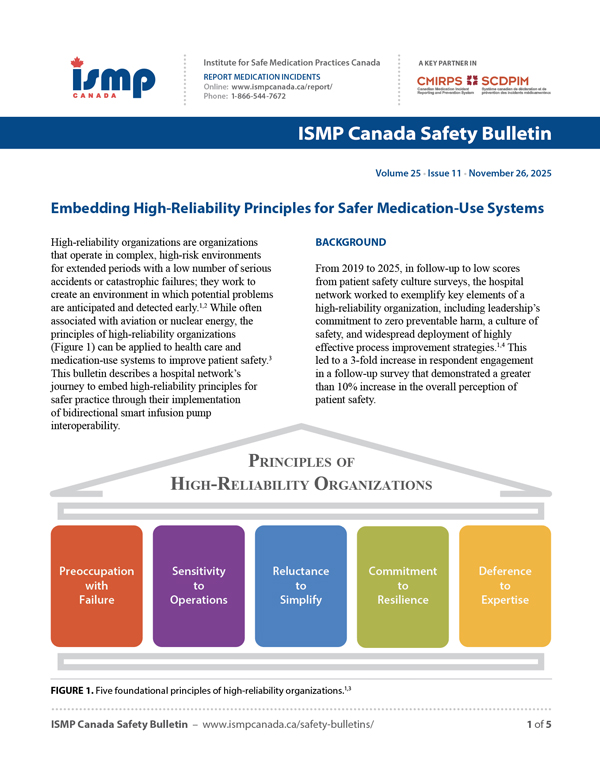
High-reliability organizations are organizations that operate in complex, high-risk environments for extended periods with a low number of serious accidents or catastrophic failures; they work to create an environment in which potential problems are anticipated and detected early.1,2 While often associated with aviation or nuclear energy, the principles of high-reliability organizations (Figure 1) can be applied to health care and medication-use systems to improve patient safety.3 This bulletin describes a hospital network’s journey to embed high-reliability principles for safer practice through their implementation of bidirectional smart infusion pump interoperability.

FIGURE 1. Five foundational principles of high-reliability organizations.1,3
BACKGROUND
From 2019 to 2025, in follow-up to low scores from patient safety culture surveys, the hospital network worked to exemplify key elements of a high-reliability organization, including leadership’s commitment to zero preventable harm, a culture of safety, and widespread deployment of highly effective process improvement strategies.1,4 This led to a 3-fold increase in respondent engagement in a follow-up survey that demonstrated a greater than 10% increase in the overall perception of patient safety.
One of the process improvement strategies employed was implementation of interoperable bidirectional smart infusion pumps. The goals of this initiative were to reduce infusion pump programming-related safety incidents and to enhance timeliness and accuracy of documentation related to infusion volumes delivered to patients. The hospital network prepared for this by completing a readiness assessment for interoperability (e.g., assessing wireless network reliability).5
Implementation of bidirectional smart infusion pump interoperability enables automatic communication between the electronic health record and the infusion pump. In one study, this form of interoperability reduced pump programming incidents by 83%.6 With interoperability in place, the medication order is auto-programmed into the infusion pump for independent verification by the nurse, and the infusion pump transmits infusion-related data (e.g., medication/fluid name, infusion rate, dose/volume administered) to the electronic health record for improved communication among members of the health care team and safer delivery of medication.
APPLYING THE FIVE PRINCIPLES OF HIGH-RELIABILITY ORGANIZATIONS: STRATEGIES LEARNED AND SHARED
Figure 1 highlights the 5 foundational principles of high-reliability organizations. Application of these principles by the hospital network, to support implementation of bidirectional smart infusion pump interoperability (for large volume and syringe pumps), is described below with examples.

Preoccupation with Failure
- Being constantly alert to, and mindful of, the potential for failure.
- Identifying and acting on small signals of failure before they escalate into harm.
Example: A failure mode and effects analysis (FMEA)7 was conducted proactively to identify the potential risks associated with each stage of the medication-use process including changes to ordering, preparation, administration, and documentation of medications.
Outcome: A total of 45 novel risks were identified before the safety initiative was implemented, allowing prevention and mitigation strategies to be embedded into the new workflow designs.
Example: Alerts indicating “severe harms averted”, provided by the infusion pump’s dose error reduction software (DERS), were monitored to help detect challenges and workarounds. A pharmacy informatics pharmacist reviewed these alerts to identify contributing factors and system solutions.
Outcome: Before the safety initiative was undertaken, the hospital network experienced 10-28 such alerts per month. Starting in April 2024, when pump interoperability was implemented, there was a significant (about 95%) decrease to 1 or 2 “severe harms averted” alerts per month (Figure 2).

FIGURE 2. Number of “severe harms averted”† alerts per month before and after a hospital network’s implementation of infusion pump interoperability in April 2024. Note: The 7 alerts triggered in November 2024 represent 3 distinct situations (including 1 with repeated attempts), all of which resulted from manual programming.

Sensitivity to Operations
- Paying close attention to what is happening on the front lines.
- Acknowledging that systems are dynamic and require constant monitoring and adjustment.
Example: Daily tiered safety huddles enabled real-time review of safety events and prompt follow-up. The first-tier morning huddle provided an opportunity for front-line staff to communicate issues, including incidents pertaining to infusion pump interoperability, and to collaboratively develop solutions with unit leadership. The second-tier huddle allowed unit managers and the department director to review identified safety concerns. The mid-morning third-tier huddle enabled each director to report to organizational leadership for review of any immediate issues affecting patient safety.
Outcome: A structured, multi-level communication system can escalate issues in real-time to support rapid problem-solving and enhance informed decision-making.

Reluctance to Simplify
- Resisting the urge to oversimplify explanations for complex problems.
- Seeking diverse perspectives and opinions to enable a richer understanding of risks and to foster the development of more comprehensive solutions.
Example: Apparent cause analysis8 was conducted to review infusion pump programming errors reported by the pump’s DERS. Subject matter experts were engaged for a deeper understanding of potential mechanisms of any system failures.
Outcome: In one case, diverse perspectives supported identification of a system-level safeguard, at the point of prescribing, to prevent the unintentional use of adult orders for pediatric patients.

Commitment to Resilience
- Developing strong systems to respond to, recover from, and learn from errors.
- Detecting problems quickly, containing them, and adapting in real time to minimize harm.
- Clearly defining behaviours and communication practices to support team-based reliability.
Example: Continuous monitoring and support were provided. Multidisciplinary debriefs after reported incidents supported learning from multiple perspectives and uncovered system-level issues that might otherwise have gone unnoticed. The approach fostered a shared mental model, including a shared understanding of the goals.
Outcome: More than 200 issues (e.g., data set misalignment, medication administration record documentation not functioning) logged by staff during the initial 6 weeks of 24-hour support were resolved.
Outcome: The proportion of voluntarily reported medication incidents related to infusion pump programming, as compared to the total number of all voluntarily reported incidents, was reduced by 80%.

Deference to Expertise
- Delegating decision-making to those with the most relevant knowledge, not necessarily those with the most seniority or leadership title.
- Empowering all team members, particularly those closest to the work, to speak up and contribute to solutions.
Example: A multidisciplinary team was engaged in structured communications. Pharmacy professionals, nurses, allied health professionals, and others (e.g., information technology [IT] team members) as needed were intentionally engaged in discussions around process design and improvement to ensure that decision-making authority lay with the team members who had the most relevant knowledge and experience. This engagement helped to promote a culture of safety.
Outcome: In one case, discrepancies in defined medication dose units between the electronic health record and the infusion pump were identified by multidisciplinary practitioners, and modifications were made by the IT team to resolve the discrepancies.
CONCLUSION
This bulletin shares a hospital network’s experience in improving the safety of a medication-use system through the adoption of high-reliability principles. Lessons shared describe the application of these principles to help identify risks early, incorporate front-line insights into decision-making, and strengthen system reliability at each stage of the initiative. Other health care organizations can leverage the learnings to advance medication safety for their patients.

The Canadian Medication Incident Reporting and Prevention System (CMIRPS) is a collaborative pan-Canadian program of Health Canada, the Canadian Institute for Health Information (CIHI), the Institute for Safe Medication Practices Canada (ISMP Canada) and Healthcare Excellence Canada (HEC). The goal of CMIRPS is to reduce and prevent harmful medication incidents in Canada.
Funding support provided by Health Canada. The views expressed herein do not necessarily represent the views of Health Canada.

The Healthcare Insurance Reciprocal of Canada (HIROC) provides support for the bulletin and is a member owned expert provider of professional and general liability coverage and risk management support.

The Institute for Safe Medication Practices Canada (ISMP Canada) is an independent national not-for-profit organization committed to the advancement of medication safety in all healthcare settings. ISMP Canada’s mandate includes analyzing medication incidents, making recommendations for the prevention of harmful medication incidents, and facilitating quality improvement initiatives.
Report Medication Incidents (Including near misses)
Online: ismpcanada.ca/report/
Phone: 1-866-544-7672
ISMP Canada strives to ensure confidentiality and security of information received, and respects the wishes of the reporter as to the level of detail to be included in publications.
Stay Informed
Subscribe to the ISMP Canada Safety Bulletins and Newsletters.
This bulletin shares information about safe medication practices, is noncommercial, and is therefore exempt from Canadian anti-spam legislation.
Contact Us
Email: cmirps@ismpcanada.ca
Phone: 1-866-544-7672
©2026 Institute for Safe Medication Practices Canada.